


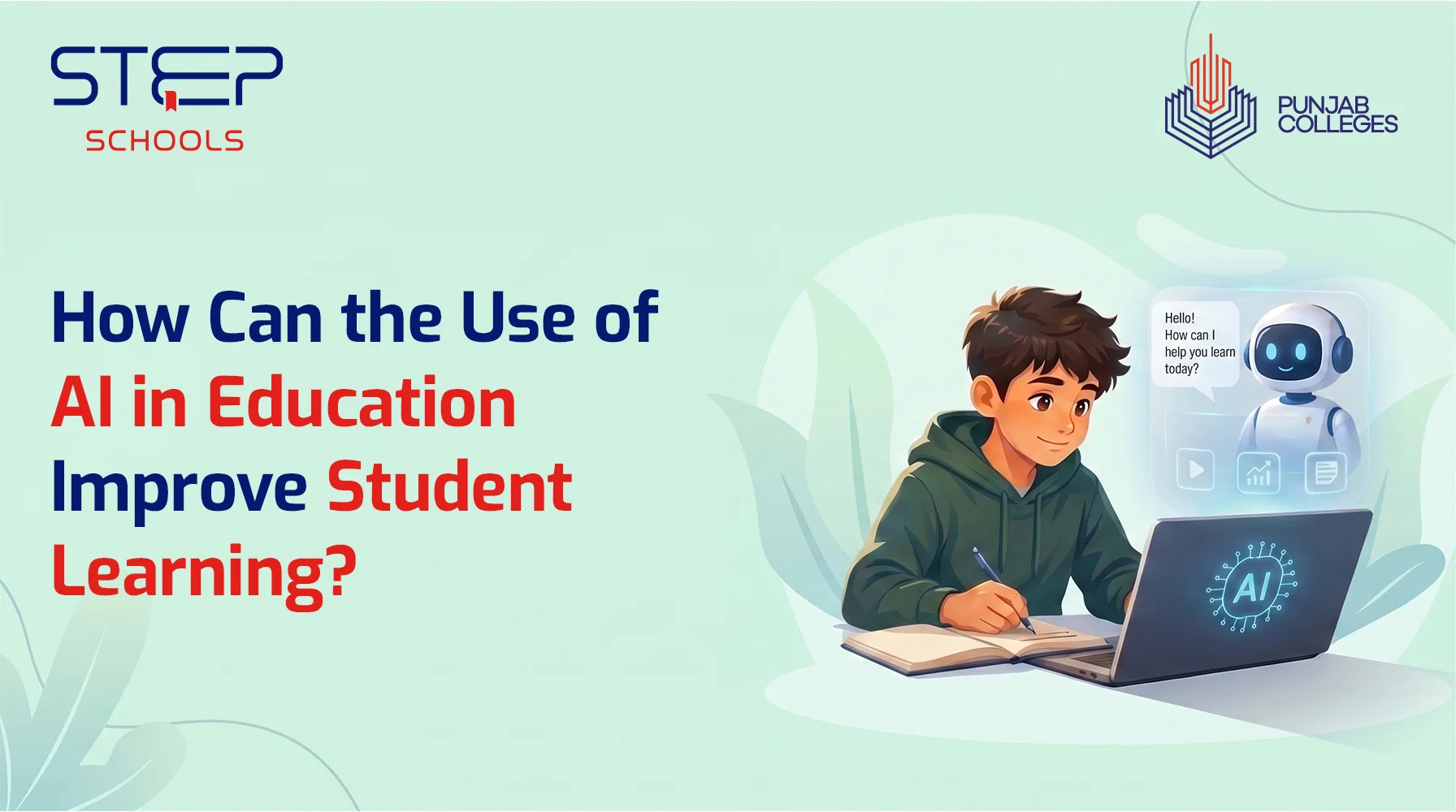
The use of AI in education is transforming the way we learn and communicate in educational settings. Artificial Intelligence in education helps students understand complex topics, practise new skills, get quick feedback, and learn according to their needs. Also, AI helps teachers save time and understand where students need more support.
STEP Schools believes in 21st-century learning. Therefore, we use modern educational approaches to help students develop skills such as creativity, communication, collaboration, critical thinking, and problem-solving. The STEP Schools curriculum also emphasises technology, STEAM, robotics, and hands-on learning.
This article explains how the use of AI in education can improve student learning. Further, we explore how AI can support teachers, the role of AI in schools, and why learning about AI can prepare children for the future. Let’s start!
What is Artificial Intelligence in Education?
Artificial Intelligence, a field of computer and data science, is defined as a technology that lets computers and machines perform tasks that usually need human thinking. These tasks include understanding language, finding patterns, solving problems, answering questions, and making predictions.
Besides, Artificial Intelligence handles many tasks more quickly with more accuracy and reliability. AI does not mean computers are becoming human, but AI uses data, computer programs, and special systems to complete tasks in useful ways. Moreover, AI decreases dependency on explicit instructions from a programmer.
Role of AI-Powered Tools
The potential use of AI in education supports fairness. It also refines classroom learning in ways that are critical and socially appropriate. Moreover, AI-powered tools adjust content to the personal needs of students, both in and out of classrooms. These tools provide adaptive tutoring and other innovations in educational technology integration. The innovation includes differentiated teaching and learning, personalised exercises, and intelligent feedback.
What Do STEP Schools Believe?
The use of Artificial Intelligence in education supports modern schools in dealing with administrative workloads, finding at-risk students, and improving schedules. Likewise, when leveraging the benefits of interconnecting AI and education, ethical considerations, transparency, and fairness continue as critically focused areas.
STEP Schools also believes that AI is becoming an imperative part of modern education. This is because it can support personalised learning, automate administrative tasks, and provide data-driven insights. Thus, AI helps students learn in smarter and more flexible ways.
What Is the Use of AI in Education?
The use of AI in education encompasses the usage of Artificial Intelligence tools and systems to support teaching and learning. In education, AI does not replace teachers, but it can work as a support tool while teachers continue to encourage, guide, and understand their students’ needs. Also, AI can be used to:
- Introduce children to modern technology
- Offer personalised learning activities to students
- Make learning more interactive
- Give Quick feedback
- Explain complex topics
- Support teachers with routine tasks
- Create practice questions
- Help students revise lessons
- Support different learning speeds
- Identify weak areas of students
The AI-focused educational approach of STEP Schools includes practical skills such as coding, robotics, and basic AI concepts. Also, our approach to technology focuses on helping young learners become confident users and creators of technology.

What Role Does AI Play in Schools?
AI is becoming a part of everyday life, from voice assistants to online learning tools. Similarly, the role of AI in schools is becoming more important as students prepare for a technology-driven world.
The World Economic Forum showcases the importance of AI in education early by stating that 40% of the workforce’s skills will change in the coming five years. For modern schools, AI is not only about using computers, but it is about preparing students for a world where technology will be an important part of their studies, careers, and daily lives. Here is how AI can support different parts of school life.
AI for Students
Artificial Intelligence makes students independent learners as they use suitable AI tools to:
- Research ideas
- Practise lessons
- Understand difficult concepts
- Generate practice questions
- Improve learning skills
- Explore technology
- Develop problem-solving abilities
AI for Teachers
There are lots of benefits of AI for teachers as well. AI helps teachers with routine activities, i.e., preparing practice questions, organising learning materials, identifying common mistakes, and creating different learning activities.
Teachers are responsible for important educational decisions. Here, AI gives more time to teachers to focus on what matters most: teaching, supporting, motivating, and communicating with students.
AI for Institution
Schools use technology to create smarter learning environments. The digital platforms by schools can help students access learning materials, complete activities, and stay connected with their teachers.
Being a modern and 21st-century school, STEP Schools already concentrates on EdTech and computer-assisted learning. Our educational technology approach includes tools such as smart boards, educational software, the STEP Portal, and e-learning resources.
What Is an Artificial Intelligence Class?
Early use of AI in education helps children understand the technology they are already using in everyday life. An Artificial Intelligence class introduces students to the basic ideas behind AI. In this class, students are taught simple concepts first before going towards complicated mathematics or advanced computer programming.
The content taught in the class depends on the student’s age and learning level. In early years, students learn about AI, basic coding, patterns, basic machine learning concepts, robotics, responsible technology use, and real-world uses of AI in AI class. The Google AI class teaches how to move from basic AI knowledge to becoming AI-fluent.
According to UNESCO’s AI competency framework for students, learners should develop skills in areas such as a human-centred mindset, AI ethics, AI techniques and applications, and AI system design. The framework encourages students to first understand AI, then learn how to use it, and finally develop their own AI solutions.

How Does AI Support 21st-Century Skills?
Education today is not about reading facts, but it involves skills development that helps students solve problems and collaborate with others. STEP Schools focuses on 21st-century learning and aims to develop skills such as collaboration, creativity, communication, critical thinking, and problem-solving. AI can support these skills when it is used correctly.
Problem-Solving
Artificial intelligence can greatly increase problem-solving abilities. It also helps students explore different solutions to a problem and compare ideas.
Creativity
Students use AI to brainstorm ideas for stories, projects, designs, presentations, and experiments. Furthermore, students then use their own creativity to develop the final work.
Critical Thinking
Critical thinking skills are highly developed by AI. This is when students do not accept every AI-generated answer, instead check their credibility first by checking, comparing, questioning, and evaluating information instead of simply accepting what AI says. This helps them become better critical thinkers and more responsible users of AI.
Communication
The communication skills of students are greatly enhanced when they use AI technology to practise writing, presentations, and communication. This whole process helps them continue developing their own voices and ideas.
Collaboration
Students can discuss ideas, divide tasks, research information, and create solutions together with the help of AI. So, AI can become one tool within remote work collaboration and group projects.
AI in Future: What Can Students Expect?
AI in the future will have a significant impact on many aspects of life. Students may notice the use of AI in education, along with many other fields, such as healthcare, engineering, business, transportation, agriculture, communication, entertainment, etc.
Moreover, AI enriches student learning when integrated with pedagogically sound approaches. Some future jobs may be completely new, while existing jobs may change because of AI. This is why children need non-technical skills, creativity, communication, teamwork, critical thinking, adaptability, and problem-solving skills as well, along with technical knowledge.
Similarly, UNESCO’s student AI framework focuses on preparing students to become responsible users and co-creators of AI, instead of becoming passive users of technology. STEP Schools focus on 21st-century learning, STEAM, technology, robotics, and problem-solving, which shows the need to prepare students for this changing world.
Prepare Your Child for the Technological Future
With the effective use of AI in Education, you can give your child the skills and knowledge needed for a technology-driven world.
APPLY NOW for STEP Schools Admissions 2026. Help your child become a confident learner and future innovator.
Final Thoughts
The use of AI in education can make learning smarter, easier, and more engaging for students. Moreover, AI can support personalised learning, provide quick feedback, boost creativity, and enhance problem-solving skills. STEP Schools prepares students for the AI future with technology, STEAM, and modern learning methods. Thus, students become confident learners and responsible future innovators with the smart use of AI.